Live AI Dream Session, Vol. 2: Computer Vision Reimagined. Thursday, September 24th, 11:00 AM ET. Reserve your Spot Claim Free Seat

Reserve your Spot

What Are the Best AI Development Lifecycle Frameworks for Regulated Analytics?

An estimated 80% of enterprise AI projects fail to deliver their intended business value, according to RAND Corporation’s 2025 analysis. In regulated industries like life sciences and healthcare, the stakes are even higher. A flawed model does not just waste budget; it can trigger compliance violations, endanger patient safety, or invalidate years of clinical research.
The core issue goes beyond the algorithm; it is the absence of a structured AI development lifecycle framework that governs how models are built, validated, monitored, and retired. Traditional SDLC processes assume deterministic outputs. AI systems produce probabilistic results that require fundamentally different governance, from data provenance to drift detection to explainability. For life sciences organizations operating under FDA 21 CFR Part 11, HIPAA, and GxP, choosing the right AI lifecycle framework is foundational.

Key Requirements When Evaluating an AI Development Lifecycle Framework for Regulated Analytics

Before comparing specific frameworks, it helps to define what “regulated-ready” demands. These are the non-negotiable considerations for any AI lifecycle framework used in life sciences or healthcare analytics.
Requirement Why It Matters in Regulated Analytics
Audit-ready documentation FDA and GxP audits require immutable records of data lineage, model decisions, and validation steps at every stage.
Explainability (XAI) Regulators and clinicians need to understand why a model made a specific prediction, particularly in pharmacovigilance and clinical trial matching.
Hallucination and drift detection LLM outputs and ML predictions degrade over time. Production AI monitoring must detect statistical drift, output toxicity, and hallucination before they affect decisions.
Model version control Every model iteration, training dataset, and hyperparameter change must be versioned and traceable for 21 CFR Part 11 compliance.
Human-in-the-loop validation Non-deterministic AI outputs require expert review gates, especially where patient safety or regulatory submissions are involved.
Cross-regulation alignment A single framework should map to multiple mandates: HIPAA, FISMA, NIST 800-53, GxP, and GDPR simultaneously.
With these criteria established, which AI development lifecycle frameworks meet these standards?

Top AI Development Lifecycle Frameworks for Regulated Analytics: A Comparative View

1. NIST AI Risk Management Framework (AI RMF 1.0)

Released in January 2023, the NIST AI RMF has become the de facto AI governance standard in the United States, organized around four functions: Govern, Map, Measure, and Manage. NIST expanded it in July 2024 with a Generative AI Profile (AI 600-1) adding over 200 actions for LLM-specific risks.FDA and other sector regulators increasingly reference its principles.
Strengths
Limitations
Best for: Enterprises needing regulatory alignment across multiple mandates (HIPAA, FISMA, GxP) without being locked into a single vendor ecosystem.

2. CRISP-DM (Cross Industry Standard Process for Data Mining)

CRISP-DM has been the most widely adopted data science methodology since 1999. Its six-phase cycle (Business Understanding, Data Understanding, Data Preparation, Modeling, Evaluation, Deployment) provides a structured, iterative approach. Comparative research found CRISP-DM showed the highest alignment with ISO/IEC 29110 standards among the frameworks analyzed.
Strengths
Limitations
Best for: Teams needing a proven analytical workflow structure, supplemented with separate governance and MLOps layers for regulated environments.

3. Microsoft TDSP (Team Data Science Process)

TDSP extends CRISP-DM with a five-stage lifecycle and adds standardized deliverables, role definitions, and collaboration templates. Its customer acceptance phase and prescribed documentation make it more enterprise-ready than CRISP-DM.
Strengths
Limitations
Best for: Organizations already operating within the Azure/Microsoft ecosystem that need standardized data science workflows across large teams.

4. MLOps (ML Operations Lifecycle)

MLOps applies DevOps principles (CI/CD, infrastructure-as-code, automated testing) to machine learning. It emphasizes continuous integration, delivery, and monitoring of ML models in production, extending traditional frameworks with automated testing, version control, and drift detection.
Strengths
Limitations
Best for: Technically mature organizations that need to scale production AI monitoring and model governance across multiple deployed models.

5. iPDLC™ (Intelligent Product Development Lifecycle) by Intuceo

Where the frameworks above address parts of the AI lifecycle, Intuceo’s proprietary iPDLC™ was purpose-built for regulated, high-stakes environments. It integrates AI-augmented engineering with PhD-led quality gates at every milestone, governing the full lifecycle from intelligent discovery through hardened production to continuous governance.
iPDLC operates across five pillars: Intelligent Discovery and Requirement Synthesis, Architectural Blueprinting, Logic-Driven Test Engineering, Hardened Production Engineering, and Observability with Continuous Governance. Each pillar includes a mandatory Human-in-the-Loop checkpoint validated by Intuceo’s Board of Science, ensuring mathematical soundness and audit readiness.
Strengths
Limitations
Best for: Life sciences, healthcare, and public sector organizations that need a compliance-first AI lifecycle framework with built-in scientific oversight and production-grade reliability.

Framework Comparison at a Glance

Capability NIST AI RMF CRISP-DM TDSP MLOps iPDLC™
Regulatory compliance (native) Partial No No No Yes
Audit-ready documentation Guidance only No Templates Tool-dependent Automated
Explainability / XAI Recommended No No Add-on Built-in (PhD-led)
Drift detection & monitoring Recommended No No Yes Yes (self-healing)
LLM / GenAI evaluation Yes (AI 600-1) No No Emerging Yes
Human-in-the-loop gates Recommended Informal Customer acceptance Optional Mandatory (every pillar)
Vendor lock-in None None Microsoft Tool-dependent Cloud-agnostic

Need a Compliance-First AI Lifecycle for Life Sciences?

Intuceo’s iPDLC™ framework delivers production-grade AI with PhD-led oversight, automated audit trails, and native compliance for 21 CFR Part 11, HIPAA, and GxP environments. Reduce implementation timelines by up to 40% without compromising scientific rigor.

Frequently Asked Questions

A traditional SDLC assumes deterministic software outputs: identical inputs produce identical results. An AI development lifecycle must account for probabilistic outputs, continuous model retraining, data drift, and ongoing validation after deployment. Regulated environments add further layers of documentation, explainability, and version control that standard SDLC processes do not address.
Primary challenges include maintaining audit-ready documentation across model iterations, ensuring explainability for clinical reviewers, detecting drift and hallucinations in production, and aligning a single AI governance framework with overlapping mandates (HIPAA, GxP, 21 CFR Part 11, GDPR). Gartner predicts 60% of AI projects lacking AI-ready data will be abandoned through 2026.
Validation requires statistical testing, human-in-the-loop expert review, automated regression benchmarks, and continuous drift monitoring. In regulated analytics, every validation step must produce an immutable record. NIST AI RMF recommends ongoing measurement across trustworthiness attributes including reliability, safety, fairness, and explainability.
Evaluation starts with baseline benchmarks during development, followed by automated production monitoring. Drift detection compares statistical distributions of inputs and outputs over time. Hallucination evaluation uses ground-truth comparison and retrieval-augmented verification. Toxicity is measured through classifier-based filters and human review. NIST’s Generative AI Profile (AI 600-1) provides over 200 specific actions for managing these LLM risks.
For life sciences, a combination approach works well: NIST AI RMF for governance structure, MLOps tooling for production monitoring, and a compliance-native methodology like iPDLC™ that embeds regulatory checkpoints into every stage. No single open framework currently covers the full spectrum from discovery through governed production in regulated environments.
What Leads to Slow Information Retrieval in Large Clinical Document Repositories?

A researcher at a pharmaceutical company needs specific safety data from a clinical trial conducted eight years ago. The information exists, but it is fragmented across regulatory filings, Clinical Study Reports (CSRs), and investigator brochures, scattered across SharePoint, a LIMS, and two legacy Document Management Systems (DMS). What should be a precise query becomes a time-consuming manual audit.
This is not an edge case; it is a systemic operational bottleneck. As clinical document repositories scale, they have evolved into “data graveyards” rather than active knowledge bases. With healthcare data volumes growing at 36% annually,  outpacing both manufacturing and finance, the infrastructure used to store this data is crumbling under the weight of its own complexity.
The root of this bottleneck extends beyond simple indexing issues. It is the result of deep-seated technical hurdles: fragmented data silos, a lack of standardized metadata, and the inherent difficulty of querying unstructured text within massive, non-machine-readable PDFs. When retrieval lags, the consequences extend beyond mere frustration – they manifest as delayed regulatory responses, compromised patient safety insights, and decision cycles that cannot keep pace with the speed of modern drug development.

$2.59B

AutoML global market value in 2025

41.96%

CAGR projected through 2031

Why Clinical Document Search Systems Fail at Scale

Retrieval latency in large clinical document repositories is rarely caused by a single factor. It compounds across several dimensions.

Unstructured Data Without Standardization

Life science organizations generate massive volumes of unstructured clinical data: handwritten physician notes, scanned regulatory submissions, multi-format trial reports, pathology narratives, and adverse event case files. This data lacks the structured schemas that conventional databases rely on. Without standardized tagging or formatting, search systems cannot index content meaningfully. A 2019 PMC study confirmed that approximately 80% of medical data remains unstructured and untapped after creation, with most hospital information systems unable to process it effectively.

Poor Document Chunking Strategies

When organizations feed clinical PDFs and regulatory filings into modern search or retrieval augmented generation (RAG) systems, document chunking becomes a critical failure point. Fixed-size chunking, the most common default, splits documents at arbitrary character counts without regard for section boundaries, tables, or clinical context. A chunk that starts mid-paragraph in a pharmacokinetics section and ends in an adverse event summary returns contextually meaningless results.
Effective chunking for clinical documents requires structural awareness, recognizing that a protocol synopsis is a single logical unit while a multi-page adverse event narrative must be segmented by case, not by page count.

Keyword Search Cannot Handle Clinical Complexity

Traditional keyword-based search breaks down in clinical repositories because medical language is inherently ambiguous. A clinician searching for “heart failure management” may need results that reference “CHF protocols,” “left ventricular dysfunction interventions,” or “HFrEF treatment guidelines,” none of which share the original keywords.
A 2025 systematic literature review of RAG in healthcare identified retrieval noise (irrelevant or low-quality retrieved information), inference latency, domain shift, and limited interpretability as persistent challenges in clinical retrieval systems. Semantic search addresses this by matching intent rather than exact terms, but many life science organizations still rely on legacy keyword engines.

Siloed Systems and Fragmented Repositories

Clinical knowledge rarely lives in one place. Trial data sits in an EDC system. Regulatory correspondence lives in a separate document management platform. Lab results are locked inside LIMS. Each system has its own access controls, metadata schemas, and search interfaces. This fragmentation forces knowledge workers to run parallel searches across disconnected platforms.
According to McKinsey, employees spend an average of 1.8 hours per day searching for and gathering information. In regulated life science environments, where document retrieval involves cross-referencing multiple systems for audit or submission purposes, that number runs highe

Missing Metadata and Taxonomy Gaps

Metadata is the backbone of fast, accurate retrieval. Without proper metadata enrichment, including document type, therapeutic area, study phase, and regulatory jurisdiction, search engines cannot surface the right results. Many clinical repositories were built over decades, and legacy documents were ingested without consistent tagging. When a repository holds millions of pages across disparate archives, missing metadata creates blind spots that no amount of search tuning can fix.

OCR Limitations on Scanned Clinical Documents

A significant portion of clinical repositories includes scanned documents: legacy trial reports, handwritten clinical notes, signed regulatory forms, and faxed correspondence. Standard OCR introduces errors that propagate through every downstream search query. Misread characters in drug names, dosage figures, or patient identifiers make these documents effectively invisible to retrieval systems. Poor PDF OCR search quality is a silent contributor to retrieval failures that organizations often underestimate.
The scale of the problem: Healthcare organizations are storing upwards of 50+ petabytes of data, retained for decades to meet compliance requirements. This data is difficult to manage, search, and analyze using standard tools.

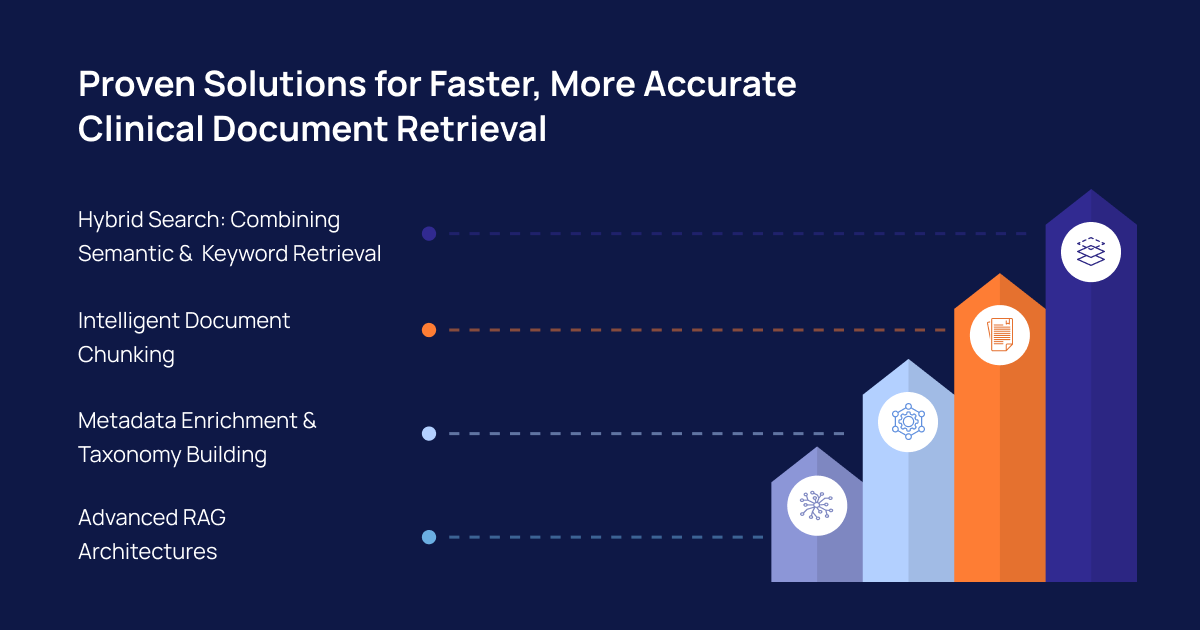
Proven Solutions for Faster, More Accurate Clinical Document Retrieval

Addressing retrieval latency in clinical repositories requires a layered approach that tackles data quality, search architecture, and knowledge organization simultaneously.
ProvenSolutionsforFaster,MoreAccurateClinicalDocumentRetrieval

Hybrid Search: Combining Semantic and Keyword Retrieval

Neither pure keyword search nor pure semantic search is sufficient for clinical repositories. Hybrid search combines sparse retrieval (BM25-based keyword matching) with dense retrieval (neural embedding-based semantic matching) to capture both exact clinical terms and conceptual equivalents.
A 2025 study evaluating RAG variants for clinical decision support found that while a Haystack pipeline (DPR + BM25 + cross encoder) and hybrid fusion (RRF) delivered the best retrieval accuracy, self-reflective RAG reduced hallucinations to 5.8%.
The optimal architecture layers both, using keyword matching for precise regulatory terms and semantic search for broader clinical concepts.

Metadata Enrichment and Taxonomy Building

Retroactive metadata enrichment using NLP-based entity extraction and classification models transforms previously unsearchable archives into queryable knowledge bases. Building a controlled taxonomy specific to the organization’s therapeutic areas and regulatory frameworks ensures search systems map user queries to correct document categories, which is critical for life science information retrieval across multi-decade archives.

Advanced RAG Architectures

Retrieval augmented generation is emerging as a critical capability for clinical knowledge retrieval systems. RAG pipelines retrieve relevant document chunks and feed them to a language model that synthesizes a grounded, contextual answer. For healthcare, this improves factual consistency and reduces hallucinations compared to standalone LLMs. However, RAG for clinical documents requires careful attention to retrieval quality; if the underlying search returns noisy chunks, the generated output inherits those errors.

How Intuceo Solves Clinical Document Retrieval at Scale

Intuceo has engineered purpose-built solutions for exactly this challenge. Intuceo-Ix™ (Neural Search Intelligence) goes beyond keyword matching to provide neural semantic discovery across fragmented institutional silos, reducing information retrieval time by 70%. Its InsightExplorer™ interface enables researchers and knowledge workers to query millions of records with sub-second response times.
For organizations dealing with legacy scanned documents and handwritten clinical notes, Intuceo-Dx™ (Document & Vision Intelligence) uses Vision AI to extract high-fidelity metadata that traditional OCR misses, converting complex analog documentation into structured, searchable records. Its RAG-enabled extraction capability lets teams query their document library as if it were a live expert.
In one engagement, Intuceo deployed a Universal Search Engine that indexed 5M+ documents across SharePoint, LIMS, PLM, clinical trials, FDA filings, and patents, transforming R&D workflows and reducing information discovery time from 90% of a knowledge worker’s day to just 10%.
All Intuceo solutions are deployed within air-gapped, HIPAA-compliant environments. No client data is used to train public models. The intelligence generated remains 100% proprietary.

All Intuceo solutions are deployed within air-gapped, HIPAA-compliant environments. No client data is used to train public models. The intelligence generated remains 100% proprietary.

Frequently Asked Questions

Retrieval slows down due to massive volumes of unstructured clinical data, fragmented storage across multiple systems (EDC, LIMS, QMS, SharePoint), inconsistent or missing metadata, poor document chunking, and reliance on keyword-only search engines that cannot interpret clinical terminology variations.
The most common causes are retrieval noise from poorly chunked documents, domain shift when embedding models are not tuned for clinical vocabulary, and incomplete metadata that prevents the retriever from narrowing results effectively. A RAG system is only as good as the documents it retrieves.
Structure-aware chunking outperforms fixed-size approaches. This involves parsing documents into logical clinical sections (safety narratives, protocol amendments, pharmacokinetic summaries) and enriching each chunk with extracted entities such as drug names, conditions, and study identifiers.
Metadata provides the filtering and categorization layer that search engines need. A well-built taxonomy maps organizational vocabulary to standardized clinical terms, ensuring queries for “adverse event reports” also surface documents tagged under “safety signals” or “AER classifications.”
The most effective approach combines intelligent chunking, entity-enriched indexing, and RAG architectures that retrieve only the most relevant segments before passing them to the model for synthesis. This keeps responses grounded in specific evidence rather than diluted across thousands of pages.

What Is AutoML? A Plain-Language Guide for Healthcare IT and Data Leaders

Healthcare organisations generate more data than almost any other industry. The problem is not the data. It is the gap between the data and the insight.
Electronic health records, imaging studies, lab results, claims data, genomic profiles, and remote monitoring streams accumulate at a scale that no human team can manually process with the speed clinical decisions require. Traditional machine learning can close that gap, but building accurate models has historically required specialised data science expertise that most health systems and life sciences firms simply do not have on staff.

Automated machine learning, or AutoML, changes that equation. It does not replace clinical judgment. What it does is make the machinery of predictive analytics in healthcare accessible to the people closest to the clinical problem. This guide explains what AutoML is, how it works in a healthcare context, where it adds measurable value, and what leaders should look for before adopting it.

$2.59B

AutoML global market value in 2025

41.96%

CAGR projected through 2031

What Is AutoML?

AutoML stands for automated machine learning. It refers to software that automates the most time-intensive steps in building a predictive model: selecting the right algorithm, engineering features from raw data, and tuning the model’s internal parameters for optimal accuracy. Steps that once took a team of data scientists weeks can be completed in hours.
Crucially, AutoML does not produce a magic black box. A well-designed platform makes the process transparent and auditable. Most enterprise AutoML tools include explainability modules that show which variables drove a prediction and by how much. This matters enormously in healthcare, where regulators and ethics committees expect clear answers about why an algorithm flagged a patient or recommended a clinical pathway.
The broader shift toward no-code machine learning and AI model automation means that domain experts such as clinical informaticists, quality analysts, and operations leaders can participate meaningfully in building predictive models, rather than waiting for centralised data science teams to prioritise their requests.

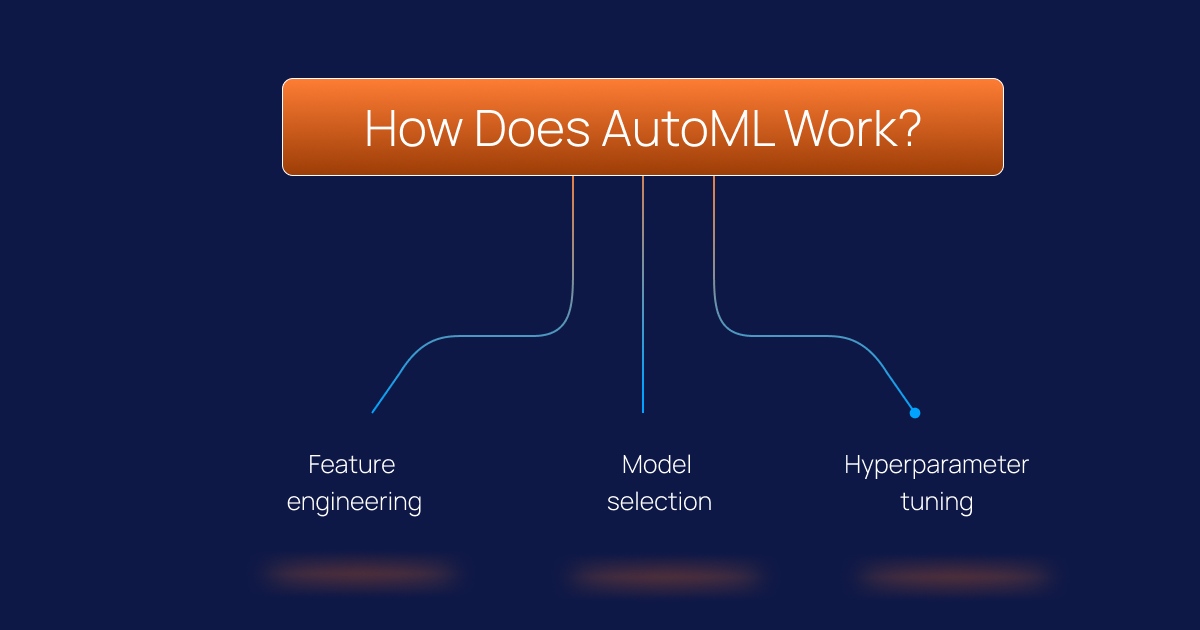
How Does AutoML Work?

An AutoML workflow moves through three core stages:
HowDoesAutoMLWork_

Feature engineering

Raw healthcare data – diagnosis codes, lab values, admission timestamps, medication lists – is transformed into numerical signals a model can use. AutoML platforms identify which transformations produce the most predictive features without manual trial and error. For structured EHR data, this stage often surfaces non-obvious signal combinations that manual feature engineering would miss entirely.

Model selection

The platform tests multiple algorithm families simultaneously, such as gradient boosting, random forests, and neural architectures, and identifies which performs best for the specific data and target outcome. This eliminates the guesswork and hours of experimentation that traditional data science workflows require.

Hyperparameter tuning

Each algorithm has internal settings that control its behaviour. AutoML systematically explores combinations of these settings and converges on a configuration that maximises predictive accuracy without overfitting the training data.
The result is a validated, deployable model built in a fraction of the time. The no-code and low-code interfaces of modern AutoML platforms mean that healthcare teams can initiate model training automation projects independently, review outputs, and iterate based on clinical feedback rather than queuing requests to a centralised data team.

AutoML Use Cases in Healthcare: Where It Matters

The following use cases represent areas where AutoML in healthcare has moved from pilot to production across health systems and life sciences organisations.

Patient Risk Stratification and Readmission Prediction

Unplanned readmissions cost the US healthcare system billions of dollars annually and remain one of the most closely watched quality metrics under CMS value-based care programmes. Machine learning models built on EHR data can predict 30-day readmission risk and in-hospital mortality with AUROC scores reaching 0.93 to 0.94 in large multi-site clinical cohorts. AutoML makes this type of modelling repeatable across facilities without requiring a dedicated data science team at every site.

Chronic Disease Detection and Early Intervention

Cardiovascular risk, diabetes progression, COPD exacerbation risk, and chronic kidney disease staging are all conditions where early prediction enables timely intervention. AutoML frameworks have been applied to coronary artery disease prediction with results demonstrating clinical-grade accuracy; when integrated with SHAP, it improves the explainability and transparency of ML models. Explainable AI in healthcare is not optional; a model that clinicians cannot interrogate will not be adopted regardless of its accuracy scores.

HEDIS and Quality of Care Analytics

Health plans operating under HEDIS and CMS STAR rating frameworks process millions of member records to identify care gaps, track chronic condition management, and optimise quality scores. Automated ML model training accelerates the cycle from data ingestion to population-level insight, enabling health plans to act on gap-in-care signals before the measurement year closes rather than reacting after the fact.

Adverse Event Detection in Pharma

Under 21 CFR Part 11 and FDA pharmacovigilance requirements, pharmaceutical companies must classify and report adverse events from clinical trials and post-market surveillance. AutoML-powered NLP pipelines can process unstructured safety reports, classify event severity, and flag regulatory submission deadlines automatically, reducing the manual burden on safety operations teams while improving reporting consistency.

Clinical Trial Patient Matching

Identifying eligible patients for clinical trials is one of the most expensive and time-consuming stages of pharmaceutical R&D. AI-driven patient matching using AutoML applied to EHR data, genomic profiles, and SNOMED CT-coded diagnoses can accelerate enrolment by narrowing a population of millions to a targeted cohort. By automating the identification of highly specific patient cohorts, AI-driven analytics can compress the clinical recruitment phase – a traditional bottleneck in drug development. In documented industry cases, integrating these automated workflows has helped reduce key stages of the drug discovery and trial lifecycle from a typical 5 to 6-year window down to approximately one year.

The Intersection of AutoML and Large Language Models (LLMs)

Dimension AWS Azure
BAA mechanism Signed via AWS Artifact for designated HIPAA accounts Auto-included in Microsoft Product Terms for qualifying customers
HIPAA-eligible services 166+ services across compute, storage, AI, analytics Service-level eligibility, validated per workload in Product Terms
Native healthcare data layer Amazon HealthLake (managed FHIR R4 + medical NLP) Azure Health Data Services (FHIR + DICOM + MedTech in one workspace)
Analytics engine Athena, Redshift, EMR, SageMaker, QuickSight Synapse Analytics, Databricks, Azure ML, Power BI
Identity backbone AWS IAM, Identity Center, KMS Microsoft Entra ID, Conditional Access, Azure Key Vault
Federal healthcare AWS GovCloud (US), FedRAMP High Azure Government, FedRAMP High, IL5
Best fit for Greenfield FHIR-first analytics, custom ML pipelines, federal health agencies Microsoft-shop hospitals, imaging-heavy workloads, integrated BI on existing M365 estates
While AutoML excels at finding patterns in structured data (like lab values and claims), Large Language Models (LLMs) like Med-PaLM 2 or GPT-4o have redefined how we handle unstructured clinical text. In 2026, the most effective healthcare AI strategies don’t choose between the two – they integrate them.

Structured Prediction vs. Narrative Understanding

The core difference lies in the data type. AutoML is your engine for predictive analytics in healthcare, turning EHR tables into risk scores. LLMs, conversely, act as the “clinical interpreter,” summarizing decades of physician notes or extracting SNOMED CT codes from messy discharge summaries.

Are LLMs Trustworthy for Clinical Decisions?

A common question among data leaders is: Can an LLM help with complex clinical decision-making? The answer is “yes, but with guardrails.” While LLMs excel at medical knowledge benchmarks, they can “hallucinate” or miss critical clinical nuances (like the difference between “suspected pneumonia” and a confirmed diagnosis).
To make a healthcare LLM clinically useful and trustworthy, it must be paired with:

Can Patients Use LLMs Safely?

Patients often ask if they can safely use AI for personal health advice. While LLMs are powerful research tools, they lack the real-time diagnostic accountability of a clinician. In a regulated setting, LLMs are best used to assist doctors – reducing administrative burnout and identifying eligible patients for clinical trials – rather than replacing human clinical judgment.

AutoML vs. Traditional Machine Learning: The Practical Difference

Traditional Machine Learning AutoML
Requires specialised data science expertise Accessible to domain experts and business analysts
Model selection is manual and iterative Automated model selection across multiple algorithm families
Feature engineering is labour-intensive Automated feature transformation and selection
Deployment timelines measured in weeks to months Model training automation reduces timelines to hours or days
Explainability depends on team capability Built-in explainability (SHAP, LIME) as standard in enterprise platforms
High cost per model at scale Lower cost per model, enabling broader deployment across use cases

What Makes a Healthcare AutoML Trustworthy?

Healthcare data science operates under constraints that most other industries do not face. Before selecting an AutoML platform or a clinical machine learning services partner, IT and data leaders should consider the following aspects:

How Intuceo Integrates AutoML in Healthcare

Intuceo is a PhD-led AI, ML, and data analytics consulting firm specialising in regulated industries. Its proprietary AutoML accelerators, part of the Intuceo-Ax platform, are purpose-built for healthcare and life sciences environments where explainability, compliance, and clinical precision are operational requirements.

Every engagement is governed by Intuceo's iPDLC methodology, ensuring that clinical domain expertise drives problem framing and outcome evaluation, not just engineering velocity.

Frequently Asked Questions

AutoML automates the most repetitive and computationally intensive parts of building a predictive model, but it does not replace the clinical domain expertise needed to define the right problem, identify the right data sources, and evaluate whether a model’s predictions make clinical sense. In practice, AutoML shifts data scientists toward higher-value work: problem framing, clinical validation, and deployment oversight.
Explainable AI refers to methods that make a model’s predictions interpretable to a human reviewer. In healthcare, this means a clinician or compliance officer can see which patient variables contributed most to a risk score and to what degree. Without explainability, clinicians have no basis for trusting or appropriately challenging a model’s output. Regulatory bodies including the FDA have signalled increasing expectations around algorithm transparency for software as a medical device (SaMD).
AutoML models in healthcare most commonly draw on structured EHR data (diagnosis codes, procedure codes, lab results, medications, vital signs), administrative data (claims, encounter history, admission and discharge records), and where available, genomic or imaging data. The quality, consistency, and completeness of that data determines the ceiling on model performance. Organisations with strong data governance and standardised EHR adoption typically see faster time-to-production on clinical machine learning projects.
AutoML platforms themselves are not inherently HIPAA-compliant. Compliance depends on how the platform is deployed, how protected health information (PHI) is accessed and stored, and whether appropriate business associate agreements are in place. Healthcare organisations should evaluate vendor security architecture, data residency options, and audit logging capabilities as part of any AutoML procurement or services engagement.
AutoML specifically refers to automation of the machine learning model-building process: feature engineering, algorithm selection, and hyperparameter tuning. No-code AI is a broader category covering tools that allow users to build AI-powered applications through visual interfaces without programming. Many AutoML platforms include no-code interfaces, but not all no-code AI tools include full AutoML functionality.

Cloud Analytics on AWS vs. Azure: Which Platform Wins for HIPAA-Compliant Healthcare Data?

In April 2025, Blue Shield of California disclosed that the protected health information of 4.7 million members had been exposed. The culprit wasn’t a cloud platform failure; it was a misconfigured Google Analytics tag that had been silently routing visitor data to third-party advertising systems for nearly three years. That is the uncomfortable truth most “AWS vs. Azure” debates miss.
For health systems, payers, and life sciences firms running analytics on PHI, the real question is not “which cloud is HIPAA compliant.” Both can be. The real question is which platform fits the workload, the data estate, and the team operating it. Also, don’t mistake infrastructure compliance for system-wide compliance. A cloud provider’s HIPAA certification covers the foundation, but your architectural choices determine whether your environment remains compliant.
This piece breaks down where AWS and Azure each pull ahead for HIPAA-compliant healthcare data analytics, what the shared responsibility model actually shifts onto your team, and how to make a defensible architecture decision.

The Shared Responsibility Model: Where HIPAA Compliance Actually Lives

A common misconception is that simply signing a Business Associate Agreement (BAA) renders a cloud workload HIPAA compliant. It does not. The BAA validates the foundation, but the responsibility for the structural integrity – configuring services, encrypting data, managing access, and providing audit evidence – remains with the customer.
The data backs this up. American Hospital Association analysis of recent OCR-reported breaches found that over 80% of stolen PHI records came from third-party vendors and business associates rather than hospitals directly, and 100% of the hacked data was not encrypted at the point of compromise. Misconfigurations, stale access, missing encryption-at-rest, and unmonitored data flows are doing the damage, not the cloud platform itself.
That makes the AWS-vs-Azure decision less about compliance posture and more about which platform makes correct configuration easier for your specific healthcare data span style=”font-weight: 400;”> workload.

AWS for HIPAA-Compliant Healthcare Analytics

AWS publishes a designated list of HIPAA-eligible services that can store, process, or transmit ePHI under a signed BAA, and the company states that its healthcare infrastructure is backed by 166+ HIPAA-eligible services along with HITRUST, GDPR, ENS High, HDS, and C5 certifications. The list expands continually; AWS PCS (high-performance computing for genomics and clinical research) became HIPAA-eligible in November 2025, and Amazon Bedrock (generative AI) was added to the list in early 2026.
For analytics workloads specifically, AWS offers a tightly integrated stack: Amazon HealthLake provides a managed FHIR R4 data store with built-in medical NLP, SMART on FHIR authorization, and Bulk Data Access APIs that align with ONC and CMS interoperability rules. Once data is normalized into FHIR, teams can query it with Amazon Athena, build dashboards in Amazon QuickSight, and train predictive models in Amazon SageMaker, all within HIPAA-eligible scope.
Where AWS pulls ahead:
The trade-off is that the AWS healthcare stack assumes you will assemble it. There is no single “Healthcare Cloud” SKU. Architects choose the building blocks, define encryption with AWS KMS, lock down identity with IAM and AWS Organizations, and demonstrate control with CloudTrail and Config.

Azure for HIPAA-Compliant Healthcare Analytics

Microsoft takes a different posture. The HIPAA BAA is not a separate contract; it is incorporated by default into the Microsoft Products and Services Data Protection Addendum and applies to any qualifying customer using a designated Online Service. For hospitals already running Microsoft 365, Teams, and Active Directory, that procurement simplicity is meaningful.
Azure’s healthcare-specific layer is Azure Health Data Services, a managed PaaS that bundles an FHIR service, DICOM service, MedTech service for device data, and a de-identification service into a single workspace. The platform is HITRUST CSF certified for HIPAA and GDPR alignment; it supports SMART on FHIR, role-based access through Microsoft Entra ID, and connectors to Azure Synapse Analytics, Azure Machine Learning, and Power BI.
Where Azure pulls ahead:
The trade-off: Azure HIPAA eligibility is service-specific, not blanket. Preview features are typically out of scope for PHI, and Marketplace solutions often require their own separate BAAs. Architects must validate the compliance status of each service before introducing PHI.

AWS vs. Azure: Side-by-Side for HIPAA-Compliant Analytics

Dimension AWS Azure
BAA mechanism Signed via AWS Artifact for designated HIPAA accounts Auto-included in Microsoft Product Terms for qualifying customers
HIPAA-eligible services 166+ services across compute, storage, AI, analytics Service-level eligibility, validated per workload in Product Terms
Native healthcare data layer Amazon HealthLake (managed FHIR R4 + medical NLP) Azure Health Data Services (FHIR + DICOM + MedTech in one workspace)
Analytics engine Athena, Redshift, EMR, SageMaker, QuickSight Synapse Analytics, Databricks, Azure ML, Power BI
Identity backbone AWS IAM, Identity Center, KMS Microsoft Entra ID, Conditional Access, Azure Key Vault
Federal healthcare AWS GovCloud (US), FedRAMP High Azure Government, FedRAMP High, IL5
Best fit for Greenfield FHIR-first analytics, custom ML pipelines, federal health agencies Microsoft-shop hospitals, imaging-heavy workloads, integrated BI on existing M365 estates

Compliance by Design: Moving Beyond Infrastructure to Architectural Integrity

Healthcare data breaches keep climbing in cost. The average healthcare breach now runs $7.42 million per incident, the highest of any industry, and the average time to identify and contain a breach in healthcare reached 241 days in 2025. The OCR breach portal recorded 725 large breaches in 2024 affecting over 275 million records.
Most of those incidents trace back to controls that were missing, misconfigured, or unmonitored, not to the cloud provider’s infrastructure.
That is where the buying decision should center. Either platform can host a HIPAA-compliant analytics environment; the true differentiator is the team’s ability to:

How Intuceo Architects HIPAA-Compliant Cloud Analytics on AWS and Azure

Intuceo deploys HIPAA-validated cloud environments on both AWS and Azure, configured for total PHI protection rather than baseline compliance. The reference architecture combines automated audit logging, VPC flow logs, at-rest and in-transit encryption, BAA-aligned protocols, and fine-grained role-based access control through Microsoft Entra ID or AWS IAM. Real-time HL7 and FHIR orchestration pipelines feed downstream analytics, and continuous compliance monitoring keeps the environment aligned with evolving HIPAA, HITECH, and HITRUST standards.
The work is grounded in healthcare experience: Intuceo’s PhD-led teams have delivered data platforms for Florida Blue, Guidewell Health, UF Health, Janssen Pharma, and Bausch & Lomb, layering Explainable AI and a rationalization layer on top of the cloud-native foundation. For organizations weighing AWS vs. Azure for HIPAA-compliant healthcare analytics, the more useful conversation is rarely about the logo. It is about which platform, configured correctly, will support the next ten years of regulatory, clinical, and AI workloads on your data.

Stop Building by Accident. Start Building by Design.

Compliance isn’t a checkbox—it’s an architectural requirement. The difference between a breach and a secure, high-performance analytics environment isn’t the cloud logo on your invoice; it’s the rigor of your design.
Don’t wait for your next audit or a security incident to uncover architectural gaps. Partner with the team that built the platforms for winning companies in the US.

Frequently Asked Questions

Both can support HIPAA-compliant workloads under a BAA. AWS tends to fit greenfield FHIR-first analytics and federal health workloads through GovCloud. Azure typically fits hospitals already standardized on Microsoft 365, Teams, and Power BI, with DICOM imaging consolidated in the same workspace as FHIR.
Yes. Microsoft’s HIPAA BAA is incorporated into the Microsoft Product Terms by default for qualifying customers, and Azure Health Data Services is HITRUST CSF certified for HIPAA and GDPR alignment. Coverage is service-level, so each service must be validated for PHI use.
AWS lists 166+ HIPAA-eligible services, including S3, EC2, RDS, Lambda, KMS, CloudTrail, HealthLake, Comprehend Medical, SageMaker, Glue, Redshift, Athena, and Amazon Bedrock. The full list is maintained by AWS and updated as new services qualify.
Most of the operational HIPAA burden lives on the customer. The provider secures the cloud; the customer secures everything in it, including encryption, IAM, network segmentation, and audit logging. Recent OCR-reported breaches show that nearly all stolen PHI was unencrypted at the point of compromise.
Yes. AWS SageMaker and Amazon Bedrock are HIPAA-eligible, and HealthLake supports FHIR-based analytics with SQL on FHIR. Azure Machine Learning, Azure Synapse Analytics, and Azure Databricks (with the compliance security profile enabled) support HIPAA-aligned analytics and AI workloads.